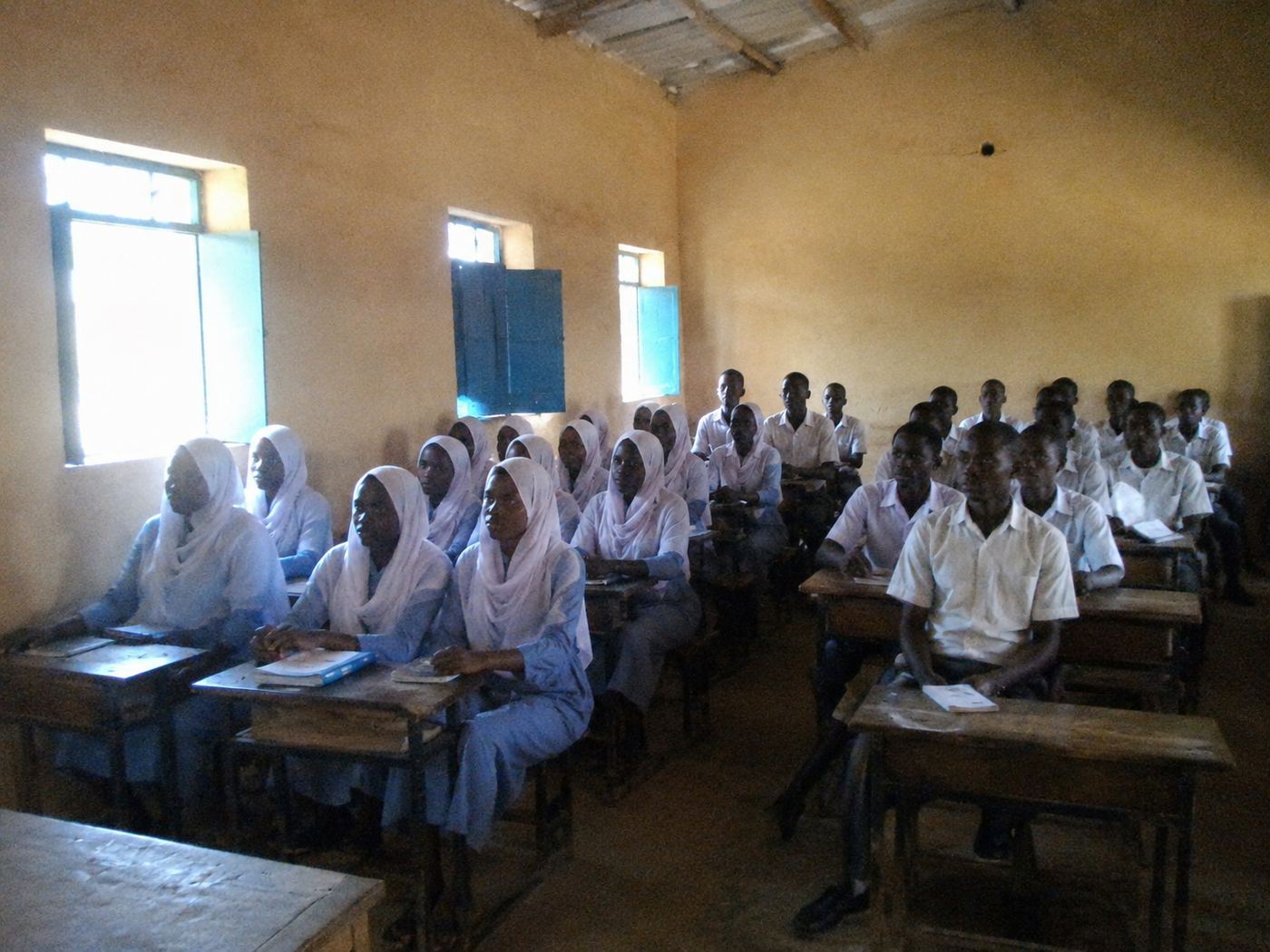
When a school stops functioning, its students don't disappear. Some walk further to another school. Some are packed into a classroom that is already overcrowded. And some — often the largest group — simply drop out of the education system altogether. In Khartoum State, more than two years into the war, this is not a theoretical scenario; it is what the documented numbers on closed schools, out-of-school children, and the widening gap between the two actually show.
This article asks a specific question: why is rehabilitating a sufficient number of government schools — rather than waiting for full reconstruction — the most urgent step for protecting the next school year in Khartoum specifically?
01Khartoum After the War: A School Crisis in Numbers
Khartoum State was the scene of the war's most intense urban battles since fighting broke out in April 2023, leaving a direct mark on the state's education infrastructure. According to data from the Directorate of Educational Affairs in Khartoum Locality, out of 450 public and private schools in the locality, only 161 are operating at an acceptable level, 240 remain under technical assessment to determine their status, and 36 have been completely destroyed[6].
The impact is even more visible at secondary level: of 54 public secondary schools in Khartoum Locality, only 25 are actually operating, after students were consolidated into 10 boys' schools and 15 girls' schools due to falling attendance. Even the schools that remain open face acute staffing shortages: boys' schools average around 8 teachers each against a required minimum of 15 (a roughly 49% shortfall), girls' schools average 7 teachers (a roughly 50% shortfall), and only 30% of required textbooks have been supplied[6].
These figures pertain specifically to Khartoum Locality, one of the state's localities, and are presented here as a documented example of the scale of the crisis within the state, given the absence of comprehensive published data for the state as a whole. The four areas targeted by the NAHDA project — Salama in South Khartoum, Al-Droshab in North Bahri, Al-Muwaileh in rural West Omdurman, and Um Dawban in East Nile — all sit within localities that have likewise seen intense displacement and return, and comparable pressure on the schools still operating.
02The Bigger Picture: Education in Sudan
Khartoum's crisis is part of a wider national one. According to UNICEF's 2025 Humanitarian Action for Children appeal, 17 million of Sudan's 19 million school-age children remained out of the classroom for most of the 2024 school year, with only 13% regularly enrolled or attending[4]. As the 2025–2026 academic year began, Save the Children reported that more than three-quarters of Sudan's children remained out of school[3]. The UN has also reported that nearly 8 million children have gone roughly 484 days without entering a classroom since the war began[1].
Structurally, the Global Education Cluster reports that 54% of Sudan's schools sit in active conflict or unstable zones, and 18% are currently being used as shelters for displaced people[8]. Save the Children documented a more than fourfold increase in violent attacks on schools and education during the first year of conflict alone, with 88 documented incidents by May 2024[2]. The result: schools still standing operate with overcrowded classrooms, severe shortages of teaching materials, and a clear shortage of qualified teachers[2].
03Why Doesn't a Student Simply Go to the Next School?
The common assumption is that when a nearby school closes, its students will simply move to the nearest functioning one. The documented reality is quite different. According to the Geneva Global Hub for Education in Emergencies, families face burdens that go beyond tuition fees to daily expenses such as transport and food, while long distances between homes and schools have already undermined many students' ability to continue their education. Tuition fees themselves have risen sharply, to around 850,000 Sudanese pounds (roughly $251.85) per student, at a time when economic collapse has brought education to a near-standstill in some areas[7]. The result: 9 million of the 12.5 million students who were enrolled before the war have still not returned to their seats two full years after they stopped attending[7].
In other words: when the neighbourhood school closes, the poorest families — already hit hardest by displacement and economic collapse — do not simply "move" to a school further away. Transport costs, time and security risks along the way make that option practically unavailable for many families, so the student drops out of education entirely rather than being redistributed to another school.
04What Have Comparable Post-Conflict Countries Taught Us?
Syria and Iraq offer two well-documented illustrations of what happens when the number of usable schools collapses faster than the number of children who need them. In Syria, one in three schools became unusable for education, either destroyed, sheltering displaced families, or repurposed for other uses, leaving roughly 1.75 million school-age children out of school[10]. Part of the response was expanding double-shift schooling to absorb as many students as possible despite fewer usable buildings, alongside targeted rehabilitation programmes that reopened classrooms that had been out of use[9]. In Iraq, schools in conflict-affected areas resorted to double- and even triple-shift schedules as a way of preserving some access to education despite widespread destruction[11].
The shared lesson from these experiences is that education systems in prolonged conflicts do not collapse because every school building disappears at once — they collapse because the number of usable schools falls faster than the number of children who need them, funnelling everyone into fewer and fewer spaces until classroom density becomes unsustainable and families begin to withdraw. What proved effective in these contexts was not waiting for full reconstruction, but rehabilitating a sufficient number of schools to a clear minimum safety and operating standard, enough to break that gradual funnelling effect.
05Rehabilitation as a Minimum Standard: How It Eases Pressure on Neighbouring Schools
This is the core logic behind school rehabilitation efforts in post-conflict settings: rehabilitating a single functioning school within a neighbourhood does not only benefit its own students — it also absorbs students who would otherwise have to walk further to a more distant school, with the transport cost and dropout risk that entails, or crowd into another nearby school that is already overcrowded itself. This is not about building new schools from scratch; it is about restoring the minimum baseline of structural safety, water, electricity and sanitation that allows a damaged — but already existing — school building to reopen its doors and take in students.
- Repairing structural damage that prevents classrooms from being used at all is what determines whether a school reopens in the first place.
- Providing clean water, electricity and functioning restrooms is what determines whether families feel safe enough sending their children — daughters especially.
- Basic educational equipment such as blackboards and desks is what determines whether a school can absorb additional students without its teaching quality collapsing.
This is precisely what makes rehabilitation grounded in an actual assessment of each school — rather than assuming every school needs the same interventions — the most efficient tool for addressing a crisis of this scale in Khartoum: it targets the specific bottlenecks preventing a given school from functioning, instead of spreading limited resources evenly across schools that may not all need the same intervention.
How Is Asham Al-Watan Working on This?
Through Project NAHDA, Asham Al-Watan Development Organization is putting this logic into practice: rehabilitating 4 government schools across different areas of Khartoum State — Salama, Al-Droshab, Al-Muwaileh and Um Dawban — starting with Salama Government School as Phase One, through an actual assessment of each school's needs followed by repair of structural damage, water, electricity, equipment and sanitation according to real priorities, enabling these schools to regain their capacity to absorb students and ease pressure on neighbouring schools, with a special focus on girls' education given that the targeted schools are girls' primary schools. For the project's full details and funding target, visit Project NAHDA.
Protecting the next school year in Khartoum does not begin with waiting for comprehensive reconstruction that could take years — it begins with rehabilitating a sufficient number of already-existing schools, one school at a time, enough to stop students from dropping out of education altogether.