A school that is operating is not necessarily a school that is capable of operating
In Sahafa, South Khartoum, one case sums up a large part of the problem we are trying to understand.
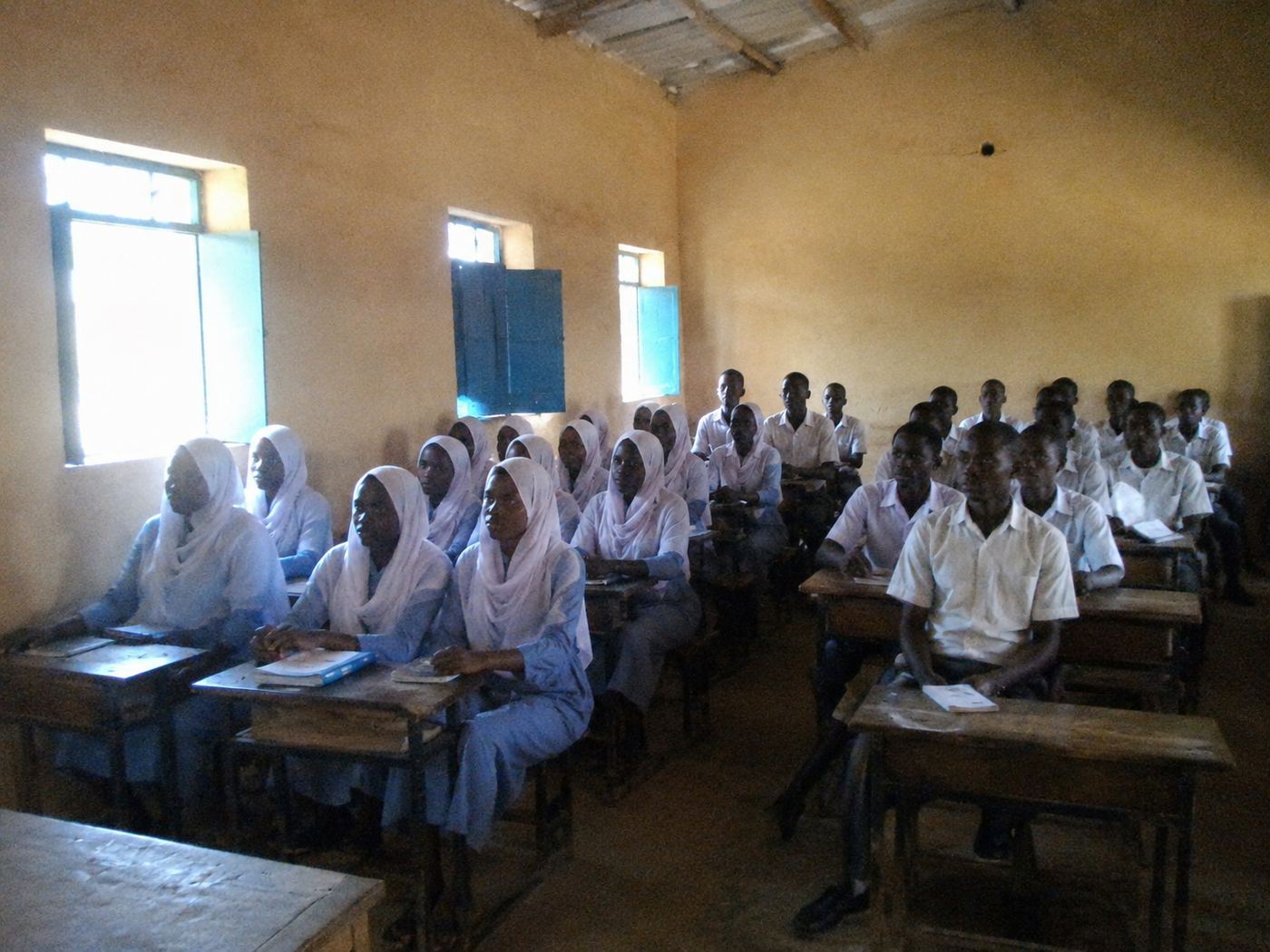
Hafsa Bint Omar Government Basic School for Girls is still operating. But the number of girls in the classroom that used to hold between 50 and 70 students before the war has dropped to only about 20, and the number of female teachers has fallen by roughly half, according to information Asham's research team obtained through local outreach and follow-up.
The school, then, is not closed.
But can we say it has returned to its normal state?
The answer is no.
This is exactly where the problem begins that we believe organizations need to look at differently.
When we say a school is "operating," that does not necessarily mean its educational capacity has returned.
Some classrooms may be unusable. The number of teachers may be below what is needed. Water or restrooms may need repair. And the school itself may be operating, but serving far fewer students than it did before the war.
In one school we followed on the ground, the number of students dropped to around 20 after the school used to serve far more, and two of its classrooms collapsed and are now out of use.
Hafsa Bint Omar Government Basic School for Girls, Sahafa, South Khartoum
The building is here.
The school is here.
But part of its ability to teach is missing.
And that is the difference between reopening a school and restoring a school to its real capacity.
Sahafa is not an isolated case
We chose Sahafa as a starting point because the outreach Asham's team carried out with schools and local bodies there gave us a picture closer to daily reality than general figures do.
In the area, some schools have returned to work to varying degrees, while others still face problems with buildings, equipment, or their capacity to take in students.
And when a school stops, or loses part of its classrooms, its students do not disappear.
The student moves to another school.
The family looks for the nearest option.
The other school takes in more students.
Then the pressure starts to show inside the school that is still operating.
This cycle repeats from one neighbourhood to the next.
Which is why the question organizations should be asking is not:
How many schools are open in Khartoum?
But rather:
How many valid educational seats are actually available to children?
And that is a big difference.
When a school stops, who carries its students?
If a school serving 500 students stops, those 500 do not stop needing an education.
Some of them may go to a nearby school.
Others may move to a private school.
Some may have to travel a longer distance every day.
And others may simply stop studying.
This last point is the most dangerous, because it often does not show up as a clear, visible picture in front of us.
A family with three or four school-age children may be able to afford a nearby school, but cannot afford the daily transport cost of sending them to a distant one.
A family may be able to afford a government school, but cannot pay the fees required by a private one.
So restoring a nearby school is not only a matter of education.
It is also relief for the family's expenses.
And a reduction in pressure on other schools.
And keeping the child inside the education system.
The Khartoum families return to in 2027 is not today's Khartoum
Return to Khartoum has already begun, but it is not complete.
More importantly, it is not the only factor that will determine the number of students in schools over the coming years.
Some children left Khartoum with their families during the war.
Some children enrolled in schools in other areas.
Some families have already returned.
Some families are still outside the capital, waiting for conditions to improve before they return.
And with every new return, the same question will come up:
Where will these families' children study?
This point must be taken seriously when planning for the 2027-2028 school year.
Because rehabilitating a school is not something that can begin at the start of the school year and finish a few weeks later.
If a school needs work on classrooms, electricity, plumbing, furniture, or painting, the project needs time, planning, procurement, execution and follow-up.
Which is why waiting for families to arrive first, then starting to prepare schools, would be exactly the wrong order.
Schools must be ready before students return, not after they arrive.
The problem does not sit in one area
Through the information gathered by Asham's research team, and through following schools and engaging with local communities, the need emerges to look at Khartoum as a network of neighbourhoods, not as a single city.
In Sahafa, we see schools operating with fewer students than before, alongside other schools that have returned to work to varying degrees.
In Deim, Sijana and East Khartoum, there are schools and education facilities that need close follow-up to know what has actually come back and what still needs intervention.
In Burri, especially in areas where families rely on schools close to home, distance and transport become an important factor when a school stops or loses part of its classrooms.
In Amarat and Mamoura, a well-known neighbourhood name does not mean every family there can afford private education or daily transport. The war has affected family incomes broadly, and the ability to pay for education has changed completely from what it was before the war.
In Kalakla and the South Belt, the return of residents overlaps with the ability of existing schools to absorb additional numbers.
In North Bahri, some schools have returned to work after long periods of closure, which shows that reopening a school's doors can be a major step, but does not necessarily mean everything has returned to normal.
And in Omdurman, some schools have returned to service after being used for other purposes in earlier periods, but they face challenges tied to overcrowding and a shortage of equipment and teachers.
The picture, then, is not a damaged school here and a closed school there.
The picture is a complete network of schools: some operating, some operating at a fraction of their capacity, and some needing intervention before they can return to service.
This is the cycle organizations must break before 2027-2028.
Not every school needs the same thing
It is a mistake to treat every school in Khartoum the same way.
Some schools are still operating but have lost two classrooms to damage.
That school may need only a limited intervention to bring those two classrooms back into use.
Another school is operating, but its electricity, plumbing, restrooms and furniture need repair.
Another school has stopped completely and needs a full restart.
Another school is in relatively sound condition, but is now taking in more students than it can handle and needs additional classrooms.
And in some areas, the school exists, but the core problem is that students live far away from it and need transport.
So the solution has to fit the school and the area, not a single template.
What should organizations do?
Based on an analysis of the cases Asham's team has reached, interventions can be grouped into a set of practical solutions.
1. Rehabilitating damaged schools
This is the first solution for cases where the school is still capable of operating, but part of its classrooms or facilities are unusable.
In a school that is actually operating, what may be needed is repairing two or three classrooms, or fixing electricity, plumbing, water, or doors and windows.
Here, the cost is not necessarily as large as some general estimates assume.
Based on Asham's local estimate for a damaged school in Salama, South Khartoum, rehabilitating a school that is already operating and needs repairs to its damaged classrooms and facilities can cost approximately:
$10,000 to $15,000
depending on the extent of the damage and the work required.
This covers the work the school actually needs to bring damaged spaces back into use, not building a new school from scratch.
This type of intervention can be relatively fast, and, most importantly, it restores seats that already existed within the education system.
2. Restarting schools that have stopped completely
The situation is different when a school is entirely out of service.
Here, repairing a wall or a classroom is not enough.
The school needs a full restart package.
Under Project NAHDA, which Asham is currently working on, the organization estimates the cost of fully restarting a school that has stopped completely at around:
$40,000
Depending on the school's condition, this cost covers:
Classrooms.
Electricity.
Plumbing.
Painting.
Chairs and desks.
Basic tools and equipment.
And the work needed for the school to be able to take in students again.
This figure is not a blanket price for every school in Khartoum.
It is an estimate based on Asham's own local work, and it can rise or fall from one school to another depending on the extent of the damage and the condition of the building.
3. Adding classrooms to existing schools
In some areas, this can be better than rehabilitating a different school.
If a school is operating, students are present, and families have returned to the area, but the number of classrooms is not enough, adding one or two classrooms can be faster and more logical than waiting for a full rehabilitation elsewhere.
Here, the decision should be based on the expected number of students, not on the shape of the building.
4. Increasing restrooms and water access
These interventions may look small in the budget, but they directly affect a school's ability to take in students.
If a school is taking in more students than before, facilities that were sufficient for 300 students may not be adequate for 500 or 600.
So water and sanitation must be part of the school's assessment from the start, not an item added at the end of the project.
5. Providing school transport
In some neighbourhoods, restoring a distant school to service may be a lower priority than providing temporary transport for students.
Especially in areas where returning families are spread over wide distances.
Transport here is not a permanent substitute for a school.
It is a solution that helps a child reach a seat that already exists, until the nearby school returns to service.
6. Supporting schools that take in students from other schools
Some schools will need help even if they were not directly damaged.
If a school starts taking in students from a school that has stopped, it needs:
Additional classrooms.
Desks.
Water.
Restrooms.
Teaching materials.
And sometimes additional teachers.
These schools should not be left out of rehabilitation plans simply because they were not bombed or did not collapse.
They are already carrying part of the educational cost of the war.
What can restarting one school achieve?
Here, the cost of intervention becomes clearer.
If a fully-stopped school can be restarted for about $40,000, the right question is not:
"Is $40,000 a large amount?"
The question is:
How many students will return to education for that $40,000?
This figure differs from one school to another.
But if, after rehabilitation, a school can take in 400 students, the cost of restoring one educational seat comes to about:
$100 per student
If it takes in 500 students:
$80 per student
If it takes in 600 students:
about $67 per student
Approximate cost per restored educational seat, assuming a school restart costing around $40,000
This way of thinking matters more than fixing a single number for the cost of a school.
Because the goal is not rehabilitating the building.
The goal is bringing the student back to school.
What about 50 schools?
Within Asham, we have raised the idea of working to rehabilitate a large number of schools before the 2027-2028 school year, and one of the targets under discussion is reaching at least 50 schools.
But the number is not a goal in itself.
If there are 50 schools that can be restarted and will serve thousands of students, that is a significant intervention.
But if 20 of them are in areas families have not yet returned to, while existing schools in other areas suffer from severe overcrowding, it may be better to direct part of the funding toward expansion, transport and facilities.
Which is why the choice of schools has to be based on actual need.
The better shape may be a mix of interventions:
Schools that have stopped completely
Restart them.
Schools that are operating but damaged
Repair the damaged classrooms and facilities.
Schools that are operating and taking in additional numbers
Add classrooms and seats.
Schools affected by students' distance
Provide transport solutions.
Schools under pressure on services
Increase water and sanitation.
This way, the rehabilitation project becomes part of a plan to restore educational capacity, not just a list of buildings to be fixed.
Where does priority begin?
We do not believe priority should be determined only by the extent of damage.
There are four more important questions:
How many students will benefit?
Is there a nearby alternative school?
Are families actually present in the area, or on their way back?
Can the school be restored to service at a reasonable cost and time?
A severely damaged school in an area that still has a small population may be able to wait.
While a school operating in a crowded area and needing two more classrooms may be more urgent.
This is why Asham does not want to choose the fifty schools from an office.
We want the choice to be tied to the neighbourhood, the number of students, the school's condition, and population movement.
What is Asham doing right now?
This research did not begin by reading reports alone.
Over the past period, Asham's research team has worked on outreach with schools, popular committees, and local bodies, gathering information from the areas themselves.
Through this outreach, we began building a picture closer to reality.
In Sahafa.
In South Khartoum.
In Kalakla.
In other areas of Khartoum.
We also engaged with the Jraif West Committee as part of our effort to understand school and community needs directly.
We do not want this information to stay inside a report.
We want it to turn into decisions.
For any school that needs intervention, we need to know:
Its condition.
Its number of students.
Which classrooms can be used.
Which classrooms are damaged.
Water.
Electricity.
Plumbing.
Furniture.
And what it actually needs to return to work.
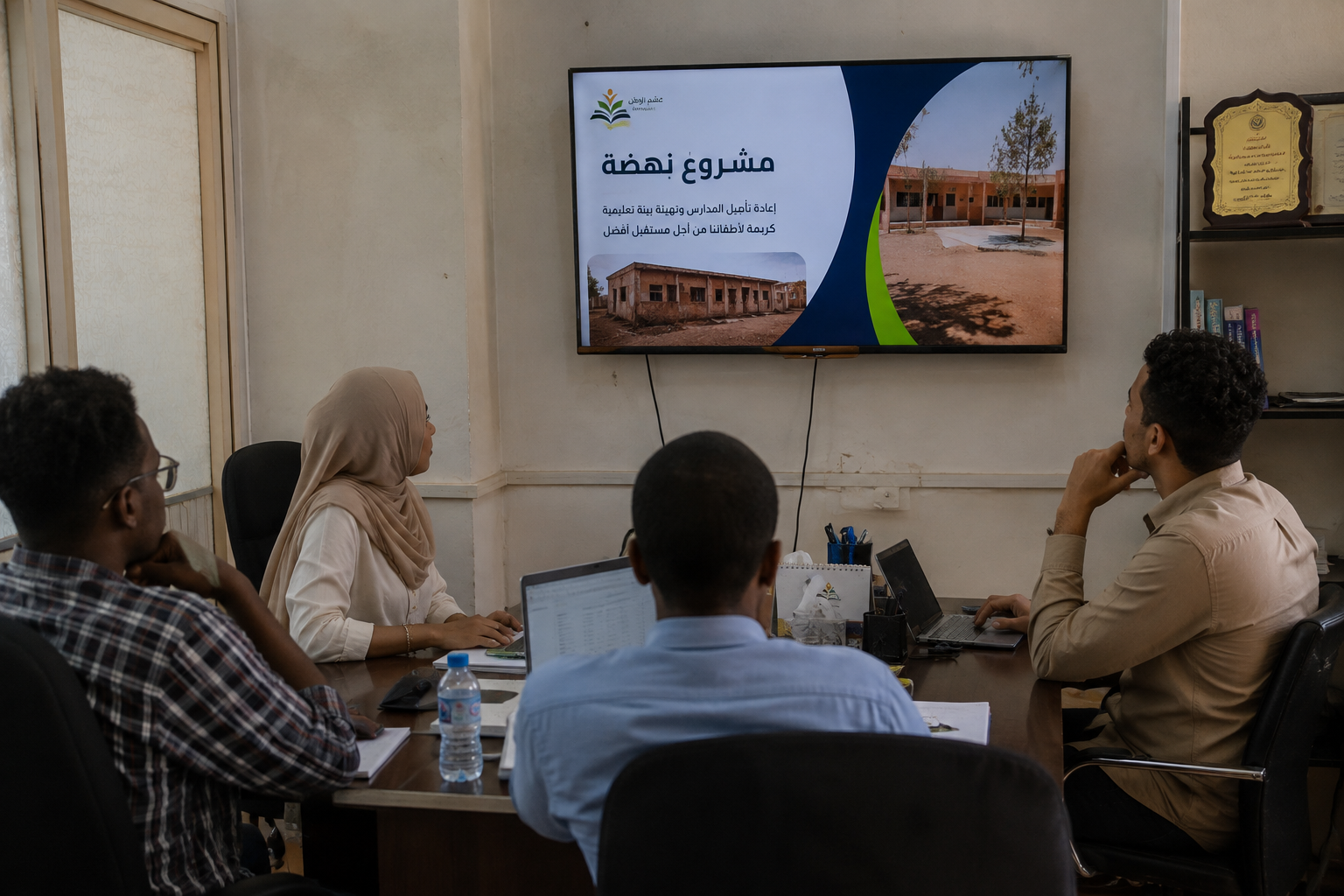
And this is how Project NAHDA to rehabilitate schools began
After gathering these observations and discussing solutions, Asham reached a clear conclusion:
We cannot wait for the problem to solve itself.
Which is why the organization began work on Project NAHDA to rehabilitate schools, a project focused on rehabilitating damaged schools and restarting schools that have stopped completely, alongside improving the learning environment in schools that need intervention.
The project started from the local reality, not from a ready-made model.

In the current phase, Asham is working on a fully-stopped school at an approximate cost of $40,000, covering maintenance and basic equipment: classrooms, electricity, plumbing, painting, chairs and desks, and the tools needed to restart the school.
For schools that are still operating but need repairs to damaged sections, Asham's local estimates point to a much smaller range, around $10,000 to $15,000, for the case the organization studied in Salama, South Khartoum.
The idea is simple:
We reach the school, understand what it needs, calculate the cost, then restore it to service.
The goal is not to build large numbers in reports.
The goal is for students to return to classrooms.
What do we need before 2027-2028?
We need the rehabilitation process to begin now.
Not at the start of the school year.
And not after families arrive and discover there is no room in nearby schools.
The next school year must begin with schools that are more ready.
More classrooms.
More seats.
Better restrooms.
Schools close to families.
And transport solutions where distance is the problem.
And most importantly, every organization needs to know where it is putting its money, and why.
| The problem | The closest intervention |
|---|---|
| A school operating with two damaged classrooms | Classroom repair |
| A school that has stopped completely | Full restart |
| A school operating but overcrowded | Add classrooms |
| Shortage of seats | School furniture |
| Pressure on water and sanitation | WASH |
| A school far from families | School transport |
| Shortage of teachers | Teacher support and deployment |
| Children who dropped out of school | Remedial education |
There is one ultimate goal: increasing real capacity to take in students.
What happens if we wait?
Schools operating today will carry a larger number of students.
Classrooms will become overcrowded.
Teachers will work under greater pressure.
Families will pay more to reach schools further away.
And families who cannot afford that cost may find themselves facing a painful choice:
Either send their children to a distant school and bear the cost.
Or choose a private school if they can.
Or pull a child out of education.
This is not a theoretical outcome.
It is a natural result when the number of students exceeds schools' actual capacity.
Which is why rehabilitating a school today may prevent a bigger problem tomorrow.
The message we want to send to organizations
Khartoum does not only need its schools to reopen.
It needs to restore its capacity to educate.
And there is a difference between the two.
A school may be open, but half its classrooms unused.
A school may be open, but with far fewer teachers than needed.
A school may be open, but its facilities are not enough.
And a school may be open, but half the children in the area cannot reach it.
So planning has to move from the question:
How many schools have we reopened?
To a more important question:
How many students have we returned to a valid, sustainable educational seat?
This is the indicator that should govern investment in education in Sudan over the coming period.
Asham does not want to wait until 2027 to know the answer
We are moving now.
We are working on damaged schools.
We are working on schools that have stopped.
We are following up on the needs of operating schools.
We are engaging with local communities and popular committees.
And we are building Project NAHDA on what we see and hear on the ground.
The goal is not to say we fixed a school.
The goal is to say a school returned to service, students returned to it, a family no longer had to search for a distant school, and another school no longer had to take in more students than it can handle.
This is the education recovery we need to start working on now.
Help us reach the schools that need support
If you know a damaged or non-functioning school in Khartoum, or a popular committee or local community that needs intervention, you can contact Asham Al-Watan Development Organization and refer the school to our research and assessment team.
Refer a school to Project NAHDALearn more about the project: Project NAHDA to rehabilitate schools